Choosing between an L-shaped, modular or designer sofa requires more than comparing photographs. You will be able to match the configuration to your room, verify comfort and construction specifications, plan delivery access, and ask a Pune manufacturer questions that expose costly gaps before you order.
Key takeaways
- Match the sofa to your room shape, circulation path and daily seating needs.
- Measure both sofa walls, doorways and lift interiors before ordering an L-shaped sofa.
- Leave clear walking space around seating, tables, doors and frequently used storage.
- Demand written details on upholstery, cushion construction, delivery access and warranty coverage.
Which sofa type fits your room and routine?
Choose by room shape, movement and daily use: an L-shaped sofa anchors a corner, a modular sofa adapts over time, and a designer sofa prioritises visual character over flexibility.
| Option | Best fit | Wrong choice |
|---|---|---|
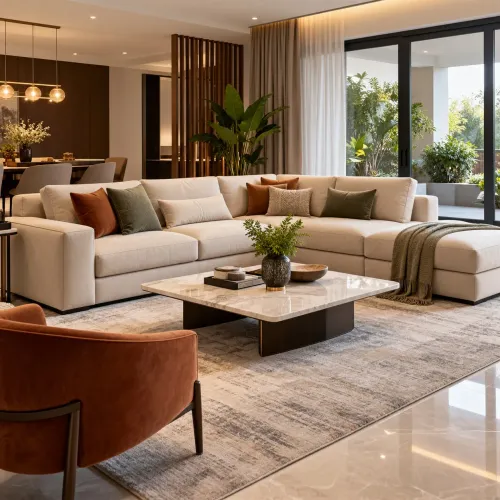
| L-shaped sofa | Open-plan rooms needing defined seating; families who want a chaise or corner seat without separate chairs | Rooms with two-sided circulation, frequent furniture changes, or uncertain orientation. Confirm whether “left-hand chaise” means the viewer’s left or the sitter’s left. |
| Modular sofa | Homes where you may split, expand or reverse the arrangement; renters and households with changing needs | Buyers assuming every “modular” model rearranges. Joined two- or three-seat frames with removable covers are not reconfigurable. |
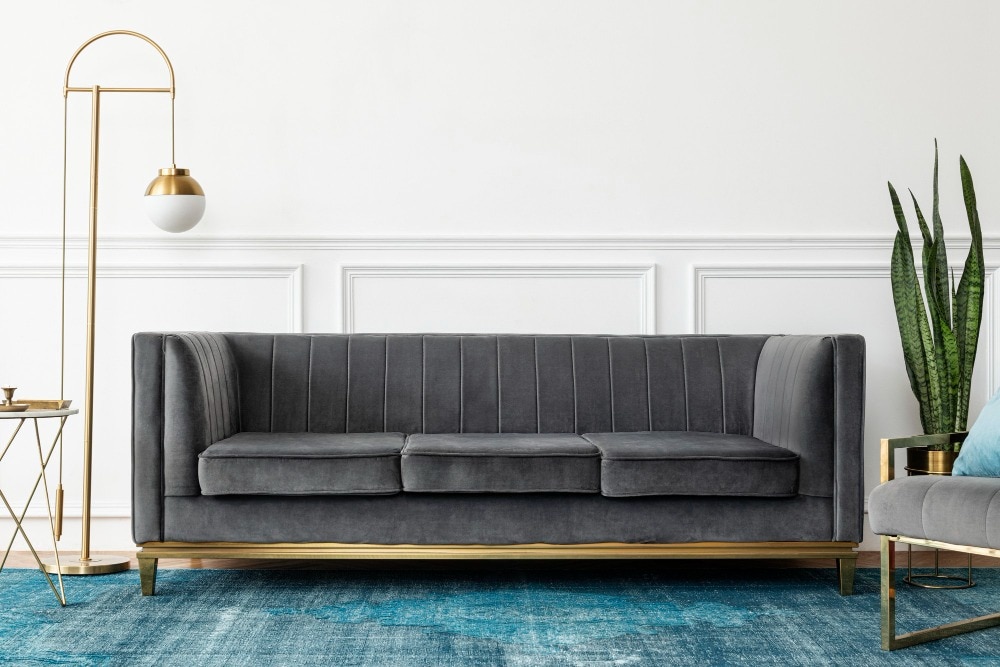
| Designer sofa | Rooms where sculptural form, unusual proportions or statement upholstery matter most | Long daily lounging, shorter users facing a very deep seat, or homes needing easy replacement parts and maximum practicality |
A Pune buyer comparing an L shape sofa Pune homes often use should check the seat before admiring the silhouette. Residential seat height is usually about 40–48 cm, with usable depth around 55–65 cm; deeper designer sofas can leave shorter users unsupported unless cushions or a raised platform compensate.
Ask a premium sofa manufacturer whether separate modules have independent legs and mechanical connectors, whether the L can switch sides, and whether cushions can be replaced. If the sofa is a major daily-use purchase, request testing details for the exact configuration, including ANSI/BIFMA X5.4 strength, durability and stability results.
Choose the correct L-shaped configuration and measure it properly
Order the orientation from the person standing in front of the sofa, not from someone sitting on it. A left-hand sofa has its chaise or return on the viewer’s left; a right-hand sofa has it on the viewer’s right.
Ask the manufacturer to state this on the quotation, because “left chaise” without a viewpoint causes frequent ordering errors.
| Configuration | Best use | Check before ordering |
|---|---|---|
| Left-hand sofa | Return on the viewer’s left | Confirm the written viewpoint |
| Right-hand sofa | Return on the viewer’s right | Confirm the written viewpoint |
| Reversible sofa chaise | Changeable chaise position | Check whether the chaise physically detaches |
| Corner or U-shaped sofa | Larger rooms and multiple seating zones | Measure every arm and return, not only the longest wall |
Measure the clear wall length, total sofa depth, and the width left after doors, windows, radiators, balcony openings and built-in units. Mark the sofa footprint on the floor with masking tape; this exposes an arm or chaise that blocks a door swing or leaves no usable walkway.
- Measure from the skirting board, not the wall’s centreline, and include the arm thickness.
- Record the narrower room dimension, because it controls whether the chaise projects into circulation.
- Measure the main door opening, lift door and staircase turns; compare each with the packaged sofa dimensions, not only the assembled size.
- Check whether a modular sofa’s sections separate and whether its connectors allow a left-to-right change. A fixed two-seat frame with removable covers is not reconfigurable.
Plan clearances for seating, circulation and everyday use
Reserve at least 75–90 cm of clear sofa walkway space along the route people use between the room entrance, seating and balcony. A tighter 60 cm path works only for occasional passage; below that, an L-shaped sofa will make the room feel blocked.
Use these practical targets before fixing the layout:
- Keep 5–10 cm of sofa clearance from a wall for cleaning and upholstery movement. Increase this to 30–45 cm behind a reclining section.
- Leave 40–45 cm of coffee table clearance between the sofa’s front edge and the table. Keep 75–90 cm beyond the table wherever it forms a walking route.
- Provide 75–90 cm of TV unit clearance in front of drawers or hinged shutters, so you can open them without colliding with knees or the coffee table.
- Keep the balcony door’s full swing zone empty. Reserve at least 90 cm from the door opening to the nearest sofa or table; sliding doors still need a clear 75–90 cm approach.
- Allow 10–15 cm between the L-shaped sofa’s outer edge and a wall or curtain, unless the chaise touches a fixed corner by design.
Mark these dimensions on the floor with masking tape before ordering. Open every door and drawer, walk the intended route, and check that the chaise does not narrow the balcony passage. A visually neat plan fails if daily movement depends on turning sideways.
Check whether a modular sofa is genuinely reconfigurable
A reconfigurable modular sofa has separate sofa modules, not merely removable covers on a permanently joined frame. Ask the seller to disconnect the actual seats, chaise and corner unit in front of you, then confirm whether the L-shape can switch from left-hand to right-hand orientation.
| Check | Fixed-frame sofa | Reconfigurable modular sofa |
|---|---|---|
| Construction | Two- or three-seat frame stays joined | Separate seats, chaise and corner pieces |
| Joining | Little or no separation hardware | Accessible sofa joining mechanism between modules |
| Stability | Usually stable as one rigid unit | Stable only when sectional sofa connectors lock securely |
| Future changes | Layout cannot change | Modules can be rearranged, added or replaced |
Inspect each connection with the sofa assembled. Push sideways at the arm and corner; movement, clicking, widening gaps or a rocking leg indicates poor alignment or weak hardware. Lift the cushions and check that every module has its own frame support and legs rather than relying on a neighbouring piece.
Ask these questions before ordering:
- Which joints separate without tools, and which require tools?
- Does the quoted price include all connectors, legs and corner units?
- Can you order a replacement cushion or matching module later?
- Is the exact configuration tested for strength, durability and stability under ANSI/BIFMA X5.4?
- What happens if the manufacturer discontinues the fabric or module?
A modular system costs more in hardware and floor space, but earns that cost when you expect to move homes, change the room layout or expand seating. Choose a fixed frame when you want maximum rigidity and will keep one arrangement.
Verify comfort, upholstery, delivery access and the written warranty
Before paying a booking advance, request a specification sheet, access plan and warranty document; a verbal promise is difficult to enforce after installation.
1. Ask for the seat construction: sofa foam density, sofa foam firmness or compression rating, cushion thickness, and whether the deck uses sinuous springs, pocket springs, elastic webbing or foam only. Density relates to material mass and durability; firmness determines how hard the cushion feels.
Also ask for the seat load rating and whether replacement cushions are available.
2. Identify the sofa upholstery material, thread or leather grade, rub or abrasion rating, cleaning method, colour-fastness guidance and warranty treatment for stains, fading, seam failure and peeling. Request a physical swatch, because a showroom sample cannot show every batch or finish variation.
3. Ask whether the exact model and supplied configuration underwent ANSI/BIFMA X5.4 sofa testing. Confirm the standard version, tested load, and whether the test covered the same frame, modules, connectors and recline features you will receive. “Premium” is not evidence of compliance.
4. Confirm orientation in writing: “left-hand chaise” must mean the viewer’s left or the sitter’s left. Include overall width, depth, height, module dimensions and packed dimensions on the order.
5. Before delivery, measure the entrance, lift door, staircase width, landing turns and ceiling height; check door swings and balcony access. Get the delivery date, floor-carry charges, assembly responsibility and damage-report procedure in writing. Kibo World should provide the same documentation for any made-to-order furniture quote.
6. Ensure the warranty separates frame defects from foam softening, upholstery wear, stitching, hardware, colour change, moisture, chemicals and natural-material variation, and states whether the remedy is repair, a replacement part or full replacement.
Frequently asked questions
Which sofa type fits different rooms and routines?
Choose an L-shaped sofa to anchor a corner, a modular sofa for future rearrangement, or a designer sofa when visual character matters most.
How do you choose and measure an L-shaped sofa configuration?
Decide whether the chaise belongs on the left or right from the viewing position, then measure both walls, the sofa depth, doorways, lift interiors and stair turns.
What clearances should you plan around a sofa?
Keep a practical walking route between seating and doors, allow space to open drawers and cupboards, and leave enough room for a coffee table without blocking circulation.
How can you check a modular sofa is genuinely reconfigurable?
Ask whether each section works independently, inspect the connectors, confirm interchangeable arm and corner units, and request the available layouts in writing.
What should you verify before ordering a sofa?
Test seat depth and cushion firmness, identify the upholstery fabric, confirm delivery access, and obtain written warranty coverage for the frame, foam, fabric and mechanisms.