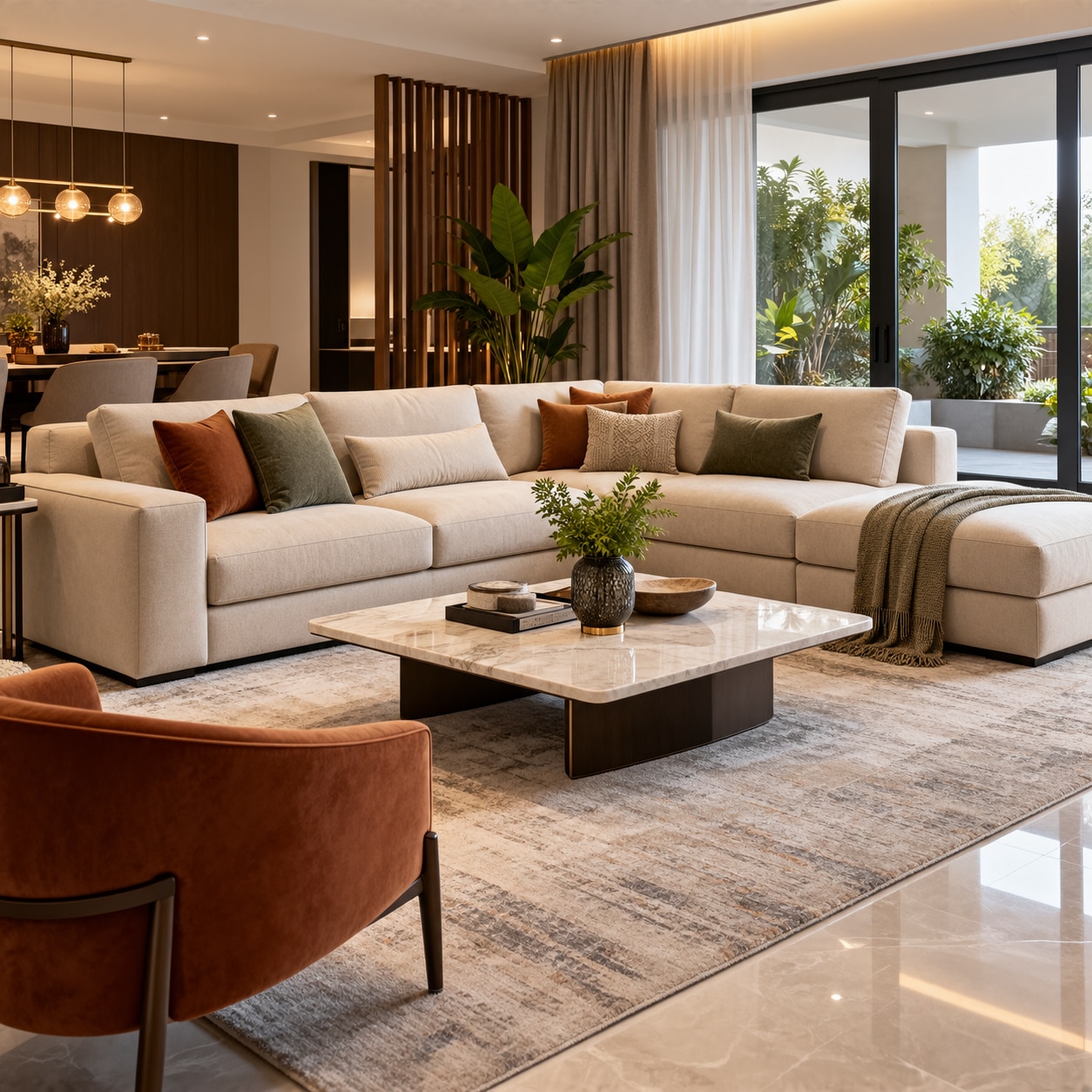
A luxury sofa is not defined by a high price or an attractive fabric sample. You need to assess its frame, suspension, foam, upholstery, proportions, delivery access and after-sales support before approving a made-to-order build. By the end, you will know what to measure, what to specify and how to compare a custom sofa with other seating options.
Key takeaways
- Ask for kiln-dried hardwood, reinforced joints and frame-fixed suspension.
- Measure doorways, lifts, stairs and clear floor space before choosing a sofa shape.
- Match cushion density and upholstery to your comfort needs and Pune’s climate.
- Compare construction, customisation, delivery effort and lifespan—not showroom price alone.
What makes a sofa genuinely luxury rather than merely expensive?
A luxury sofa proves its value in the parts you cannot judge from a showroom photograph: frame construction, suspension, cushioning and upholstery. Ask for kiln-dried hardwood in load-bearing rails, properly glued and screwed joints, reinforced corners and a suspension system securely fixed to the frame. A vague claim of “solid wood” proves little.
Engineered wood frame construction can perform well when it uses correctly specified plywood or blockboard in the right areas. Particleboard deserves closer scrutiny because moisture and repeated screw loading can weaken it. Ask who builds the frame and how repairs are handled before you place the order.
- Request the seat foam density in kg/m³, not only “high-density foam.” Confirm the back cushion filling, expected softening and whether replacement cushions can be ordered.
- Check that seat depth means usable sitting depth after back cushions, not the sofa’s total front-to-back measurement. A deep seat may suit lounging but leave shorter users unsupported.
- Inspect stitching, seam alignment, piping, cushion zips, leg fixing and the consistency of exposed wood or lacquer.
- Ask for a physical upholstery swatch, cleaning instructions and lightfastness information. Abrasion ratings do not prove resistance to stains, fading, snags or pet claws.
| Detail | Expensive-looking shortcut | Luxury evidence |
|---|---|---|
| Frame | Solid-wood label | Kiln-dried hardwood, plywood or blockboard specified by location, with reinforced joints |
| Suspension | Sagging webbing hidden underneath | Correctly tensioned webbing or springs attached securely to the frame |
| Cushions | Soft on day one | Stated foam-and-fibre or feather construction with a clear maintenance and replacement plan |
| Finish | Decorative fabric alone | Even stitching, stable proportions and upholstery suited to daily use |
What happens during a made-to-order sofa project?
The first site visit should end with more than a room sketch. It should confirm the sofa’s dimensions, access route and brief before anyone discusses upholstery or deposits.
1. The site measurement records room length and width, wall clearances, doorway and lift dimensions, corridor width, stair turns and the final position. For a modular sofa, test each module’s ability to rotate through these points; a floor-plan fit does not guarantee delivery access.
2. The brief fixes the adjustable dimensions: overall width, seat height, seat depth, arm width, back angle, leg height and module layout. Confirm which parts are fixed by the manufacturer’s frame or foam tooling, then compare the drawing with your furniture and walking clearances.
3. Before design approval, request a scaled drawing and material schedule showing fabric code, cushion construction, foam density, firmness or ILD, thickness, leg finish and hardware. Complete a prototype review using a corner, cushion or full-size sample, and record every change in writing.
4. The quotation should state the connector type, whether it remains accessible after installation, and whether covers or cushions can be replaced individually. Also ask who builds the frame, sews the covers and handles repairs.
5. During production, approve any upholstery or colour sample before cutting. At delivery, inspect dimensions, seams, alignment and finish before signing; installers should assemble modules, secure connectors and level the legs. Keep the delivery assumptions, warranty exclusions and remedy for dimensional or finish defects with your approval record.
This is the made-to-order sofa process from measurement to handover.
How should you measure a Pune home and choose the sofa shape?
Measure the room, the delivery route and the space each person needs before choosing a sofa shape. Record wall-to-wall length and width, ceiling height, doors, windows, radiators and power points. Keep roughly 750–900 mm for circulation and 400–450 mm between the seat edge and coffee table.
Record these sofa measurements before approving a drawing:
- Room: usable wall lengths, corner-to-corner diagonals and the clearance needed to open doors or drawers.
- Access: doorway and lift dimensions, corridor width, stair width, landing depth and the tightest turn. Measure with handrails and door closers included.
- Seating: seat height, seat depth, back height, arm width and the number of regular users. A deeper seat suits relaxed lounging; a shallower seat supports upright sitting.
- Modules: the largest section’s length, width and diagonal. Ask for the connector type, whether it remains accessible after installation and whether one cover or cushion can be replaced without dismantling the sofa.
| Shape | Choose it when | Check before ordering |
|---|---|---|
| Straight | The room is narrow or seating faces one wall | Confirm circulation at both ends |
| L-shaped sectional | You need a corner seat and clear TV-facing orientation | Check the chaise does not block a door or passage |
| U-shaped sectional | A large, open room needs group seating | Confirm the central opening and delivery turns |
| Curved | You want conversation seating in a spacious room | Measure the curve’s deepest projection and access route |
| Modular | You may rearrange seating or need staged delivery | Ensure every module fits the doorway, lift, corridor and stairs; floor-plan fit alone is not enough |
How do you specify comfort and upholstery for Pune’s climate?
Define comfort with measurements, not the word “premium.” State the seat firmness you want—supportive, medium or sink-in—along with the usable seat depth, seat height and back angle. A deep seat suits lounging but can leave shorter users unsupported unless the back cushion or depth is adjustable.
Put the cushion construction in writing:
- Foam density, firmness or ILD, thickness and whether the seat uses one foam layer or layered foam
- Fibre or feather wrap, if used, and the plumping frequency it requires
- Removable seat and back covers, plus the cost and availability of replacements
- Which dimensions can change: seat depth, seat height, arm width, back angle and module layout
Foam density and firmness are different. High-density foam can feel soft and retain its shape, while low-density foam can feel firm at first and lose height sooner. Foam-and-fibre cushions offer a softer appearance with less daily plumping, but they are not maintenance-free.
For fabric, ask for abrasion performance, colourfastness, pilling resistance, weave tightness and cleaning instructions. Assess linen upholstery Pune climate performance before choosing it: Pune’s dust, humidity and monsoon drying time make removable covers, ventilation and manufacturer-approved cleaning important. Never leave cleaned upholstery damp; trapped moisture causes odour or mildew.
Ask who builds the frame, sews the covers and handles repairs. Confirm the workshop’s replacement-cover and cushion policy, because a showroom or design studio does not prove that future servicing happens in-house.
Which seating solution and manufacturer offer the right long-term value?
Choose a custom luxury sofa over a showroom sofa when your room, access route or comfort requirements fall outside standard dimensions and you expect to keep the piece for years. The custom sofa versus standard sofa decision is not about appearance alone.
| Option | Long-term value | Choose it when |
|---|---|---|
| Custom luxury sofa | Best fit, comfort and repairability; higher lead time and cost | You need specific width, seat depth, arm width, back angle, fabric or module layout |
| Showroom sofa | Immediate purchase and predictable price; limited proportions and materials | A standard size fits the room and you accept the available comfort |
| Modular sectional | Reconfigurable seating; connectors and delivery access matter | You may change the layout and each module fits the lift, corridor and stair turns |
| Loose-cover sofa | Covers can be removed for cleaning or replacement; fit and drying need attention | Pune dust and monsoon moisture make washable covers useful |
| Built-in seating | Maximum space efficiency; difficult to alter or remove | The seating is designed with the room and will remain in that location |
Before paying a deposit, obtain a scaled drawing and confirm which dimensions are adjustable, not merely “made to order.” Request the fabric code, cushion specification, frame and suspension details, leg and hardware finish, connector type, warranty exclusions, delivery assumptions and a written remedy for defects.
Ask Kibo World, or any sofa manufacturer in Pune, who builds the frame, sews the covers and handles repairs. Confirm replacement covers and cushions, connector access after installation, approved cleaning methods and realistic drying arrangements. Verbal promises are not a specification.
Frequently asked questions
What makes a sofa genuinely luxurious rather than merely expensive?
Look beyond appearance and ask about kiln-dried hardwood load-bearing rails, glued and screwed joints, reinforced corners, secure suspension and the upholstery and cushioning specification.
What happens during a made-to-order sofa project?
You typically define the sofa’s dimensions, shape, comfort, upholstery and finish before the manufacturer builds it to those specifications. Confirm measurements, materials, lead time and delivery access in writing.
How should you measure a Pune home before ordering a sofa?
Measure the available floor area plus doorways, lift interiors, stair turns, corridors and ceiling height. Use those dimensions to select a shape that can enter the home and fit the room.
How do you choose sofa comfort and upholstery for Pune’s climate?
Specify the seat feel, back support and cushion construction directly, then compare upholstery for breathability, sunlight exposure, cleaning needs and everyday use in Pune’s climate.
Which seating solution offers the right long-term value?
Compare frame construction, suspension, cushioning, upholstery, fit, repairability, delivery access and expected use rather than choosing by price or showroom appearance alone.